How to Create Flash USDT Using ChainIDE and MetaMask
· based on the channel Rca FastPrint
Flash USDT is a method for creating USDT-like ERC20 tokens on the Ethereum blockchain using a smart contract development workflow. This process is facilitated by the ChainIDE platform, which provides a comprehensive development environment for coding, testing, and deploying smart contracts. MetaMask serves as the wallet interface to connect with the Ethereum network and interact with the deployed contracts. For those interested, ChainIDE offers registration and a free platform at https://chainide.com/.
Understanding the Flash USDT Concept
Flash USDT represents a newly discovered method to create ERC20 tokens mimicking USDT functionality. The technique involves writing a smart contract that follows the ERC20 token standard, which defines the interface and behavior of tokens on Ethereum. By deploying such a contract, users can generate tokens that behave similarly to USDT for testing, development, or educational purposes. This approach does not imply creating official USDT tokens but rather simulating them within a controlled environment.
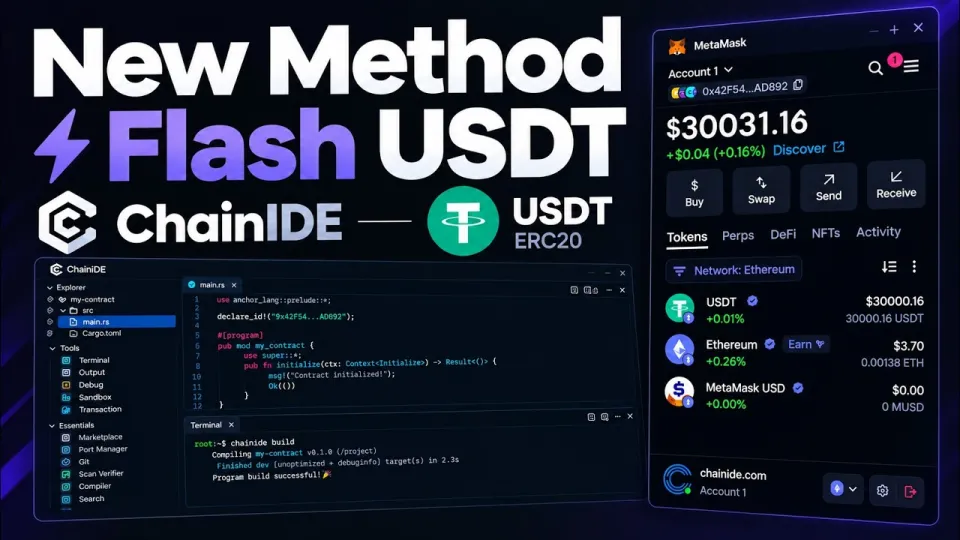
Setting Up ChainIDE for Flash USDT Development
ChainIDE is an online integrated development environment tailored for blockchain projects. To start creating Flash USDT tokens:
- Register or log in at https://chainide.com/.
- Create a new project and select the Solidity language for smart contract development.
- Use the provided Flash USDT script template available at https://sites.google.com/view/defiflashusdt as a base.
- Customize the contract parameters such as token name, symbol, and total supply as needed.
- Compile the contract within ChainIDE to ensure there are no syntax errors.
Using ChainIDE simplifies the coding and deployment process by integrating compilation, testing, and deployment features in a single platform.
ERC20 Token Structure and Flash USDT
The core of Flash USDT lies in the ERC20 token standard, which defines several key functions:
- `totalSupply`: Returns the total token supply.
- `balanceOf`: Returns account balance of a specific address.
- `transfer`: Transfers tokens to another address.
- `approve` and `transferFrom`: Allow delegated transfers.
The Flash USDT contract implements these functions to mirror USDT’s behavior. Understanding this standard is essential for anyone creating or interacting with Flash USDT tokens, as it ensures compatibility with wallets and exchanges supporting ERC20 tokens.
Connecting MetaMask to Interact with Flash USDT
MetaMask is a browser extension wallet that connects users to the Ethereum blockchain. To test or use Flash USDT tokens:
- Install MetaMask and set up a wallet if you don’t have one.
- Connect MetaMask to the Ethereum network (mainnet or testnet as required).
- Link MetaMask with ChainIDE by enabling wallet connection within the development environment.
- After deploying the Flash USDT contract, use MetaMask to interact with the contract functions such as transferring tokens or checking balances.
MetaMask provides the interface for signing transactions and managing tokens, making it a vital tool in the Flash USDT workflow.
Smart Contract Development Workflow for Flash USDT
The workflow involves several critical phases:
- Coding: Write the ERC20-based smart contract code in Solidity within ChainIDE.
- Compiling: Use ChainIDE’s compiler to check for errors.
- Deploying: Deploy the contract to the Ethereum network, which requires paying gas fees with ETH.
- Testing: Interact with the contract via MetaMask to confirm proper functionality.
- Verification: Verify the contract source code on block explorers to ensure transparency.
This structured process helps prevent common mistakes and ensures the contract behaves as expected before real-world use.
Common Mistakes and Precautions
When creating or interacting with Flash USDT contracts, be cautious about the following:
- Always verify the contract address and source code independently.
- Do not send real funds to unknown or unverified contracts.
- Check network selection in MetaMask to avoid sending transactions on the wrong network.
- Review transaction details carefully before signing.
- Use testnets for development and testing to avoid losing actual assets.
By following these precautions, users can safely explore Flash USDT creation and interaction.
Useful Links
- ChainIDE development environment: https://chainide.com/
- Flash USDT script and guide: https://sites.google.com/view/defiflashusdt
Итог
Creating Flash USDT tokens involves deploying an ERC20 smart contract through ChainIDE and interacting with it using MetaMask. This method offers a practical way to understand token creation, smart contracts, and the Ethereum ecosystem in a controlled setting. The workflow covers writing Solidity code, compiling, deploying, and testing, emphasizing the importance of verification and security. For an in-depth breakdown of this method, the channel Rca FastPrint provides valuable insights and tutorials. To get started, visit ChainIDE and explore the platform’s features for blockchain development.
Key takeaways
- Flash USDT is an ERC20 token created via smart contracts on Ethereum.
- ChainIDE is used as the development environment for coding and deploying Flash USDT.
- MetaMask connects the user wallet to the Ethereum network and interacts with the contract.
- The method involves understanding ERC20 token structure and smart contract deployment.
- Testing and verification are crucial before using any Flash USDT contract with real funds.
Questions & answers
What is Flash USDT and how does it differ from official USDT?
Flash USDT is a user-created ERC20 token that mimics USDT functionality for testing and development. It is not official Tether (USDT) but a simulated token created via smart contracts.
Can I use Flash USDT tokens with real money?
No, Flash USDT tokens should be used only for educational or testing purposes. Sending real funds to unknown contracts is risky and not recommended without thorough verification.
What role does ChainIDE play in creating Flash USDT?
ChainIDE is an online Solidity development environment used to write, compile, and deploy the Flash USDT smart contract on Ethereum, simplifying the development workflow.
How does MetaMask interact with Flash USDT contracts?
MetaMask acts as a wallet and interface that connects to the Ethereum network, allowing users to send transactions, check balances, and interact with the Flash USDT smart contract functions securely.
Source: Flash USDT | Found a NEW Method on ChainIDE · Markdown version